Tag: gifted

  • 7 Tips For Transition From Mainstream Education To Gifted Education Programme (GEP)

    Character from book project and 3D book review

    Every Primary (Grade) Three student in Singapore is given a chance to sit for a screening test to test for giftedness in English, Mathematics, and General Ability (traditional IQ questions). Up to 10% students get through the first round, and then only the top 1% to 1.5% make it to the Gifted Education Programme (GEP). Apart from developing the students’ intellectual capacity and higher level thinking, it aims to provide future leaders for the small country.

    There are parents who simply want their children to get into the gifted stream, so they fork out money to send their children for training, so that the children could get into GEP. Unfortunately, their children may feel very stressed when they realise they are unable to cope with the rigours of the curriculum. Since being gifted usually means being in the top 2%, there will be some children who will not be selected. Perhaps they are asynchronous in different areas – some might be extremely strong in mathematics and science, the latter being not tested, but do not read sufficiently to have an extremely large vocabulary to qualify for the programme. Others might have topped their cohorts consistently, but they are just extremely bright, not gifted. Nevertheless, since the GEP students are selected for their English, Mathematics and General Ability, almost all should be able to cope with the curriculum.

    El managed to get into the programme, along with two other classmates. The gifted programme curriculum is definitely more challenging and interesting than the mainstream curriculum. The students get to learn about ancient civilisations, such as the Mayan number system in Mathematics. They write short stories, fractured fairy tales (the teacher was pleasantly surprised that he wrote a poem in Roald Dahl’s Revolting Rhymes style) and book reviews. The poems offered are quite interesting too. They do literature, which is usually reserved for secondary school (grades 7 – 10) students and the book is A Single Shard by Linda Sue Park. They also could find articles on any interesting ideas that are not taught in the curriculum, things such as the hottest place on earth, the coldest matter invented, and orchids are tricksters.

    It is definitely tough for both parents and students to make the transition from mainstream education to the gifted programme. El’s number one challenge he faces is the sheer amount of homework. Even in the third school term right now, there are still a lot of things to be concerned about. Here are some things that could help with being better prepared for GEP.

    Tip 1: Connect with other parents

    I managed to find on a local forum other parents whose children were going to the same school, so we formed a group and met up prior to reporting to the school. We wanted to let the children know a few other friends first before going to school.

    The school also helped each class to start a parents’ WhatsApp group, and since I already had a few numbers, I was one of the class reps. One of the form teachers knew my job, and she expressed surprise that I was ‘free’ to manage the group. It did not take too much time actually, since most people just knew what to do, such as collating phone numbers and names of parents and children. The two groups I was in allowed me to quickly know the school culture, and we provided information on all sorts of things, such as when and where to get the books and supplies, when to request for school bus services and also academic matters. Issues cropped up along the way, and parents surfaced them, hoping to find answers.

    Tip 2: Connect with teachers and other educators

    The teachers formed Class Dojo groups, and the teachers posted updates and pictures regularly especially in the beginning. Parents could easily message them and seek clarification. There were a few school events, so we could meet up with the teachers to have informal and formal chats. There were also a few meetings with the school principal and department heads about the programme. There was also a talk by a parent (who is an educator too) whose child graduated from the programme. She said that it was fine if we could not answer the questions in our children’s homework since they are the ones who are gifted, not us.

    Tip 3: Manage homework well

    Homework used to be a short piece of assignment. Now, there are major projects, reports and assignments. Help your child to learn to cope with deadlines. There are many occasions when El has to do his work late into the night. Many of the assignments require the use of the computer and printer. This means running to the nearby shopping mall to pick up ink cartridges because the printer ran out of ink. There were also multiple drafts required for them to improve their work. El used to be resistant to doing new drafts. I had to coax him and tell him what to do with the teachers’ detailed comments. There were a few occasions when his name was highlighted for non-submission on his teachers’ blogs, so I had to ensure he was completing and submitting his work. There were days when I had to sit near him, just to check that he was doing his assignments, and not secretly going to other webpages, such as checking out Harry Potter trivia (his latest interest), or working on a Scratch project (which is part of his programme). He has to learn Chinese spelling as well on a regular basis, and there are long paragraphs to memorise. That takes time too.

    Tip 4: Organise things well

    There is so much filing to be done since they do not use textbooks. They were told to get an accordion file and label various subjects with In and Out compartments. Their files are constantly checked and rechecked. Worksheets are numbered. This is a good idea as it ensures the students complete their assignments.

    We actually bought two cupboards and placed them in the living room. El had one and Gar (who just started primary school) had another. Each subject had its own shelf, and their bags were at the bottom shelves. We could leave the house easily in the morning. They would pack their bags the night before, but there were days when they forgot to pack the reading material in the right language, and had to rush to find one.

    Tip 5: Manage time properly

    With so many assignments that span days, weeks or months, they need to be at the top of their game. Work no longer takes just minutes. They take hours. Parents have to help the child plan a timetable, so that they will not miss deadlines. El is tired from the many enrichment courses organised by his school (computing, debate, competitions, fieldtrips and performances) and after-school club activities. He had trouble coping with work and had no time for other pursuits such piano. It is only recently after he managed to clear his backlog of homework that he could get back to practising piano. Initially, he was upset at having no time at all, but I think he is getting used to the rigour. He has to cope with the Chinese spelling too. He wanted to quit everything and not do anything, but he would just end up playing games on iPad instead of using it meaningfully. We managed to talk it out.

    Time is needed for the students to read! They have over 50 books on a booklist. I went to the National Library Board to search for books on the list. Since I love reading and I can speed read, I read some books together with him, so that I could discuss the stories with him. Some of the more interesting books include Frindle by Andrew Clements and Clockwork by Philip Pullman. El likes reading, so he managed to read quite number on the list. It is fine to stop reading if he dislikes the books, and there are some books that he is not so keen on.

    Tip 6: Manage stress

    The stress gets to both the children and the parents. It was really tough for the children as many of them cruised through the lower primary levels, scoring fantastic grades without putting in much effort. Suddenly, they have to actually use their brains. It is tough for children. There are people who think GEP kills interest and creativity in children, but I think El actually got to express his creativity more. He came up with a 3D book review and a snakes and ladders game based on a Chinese book he had to read. There was a lot of tension in the beginning. Parents should not do their children’s homework or projects, but just guide them closely. There were times when I felt it would be faster if I just took over, but I made him learn how to do it, such as learning how to make the background of a picture disappear using PowerPoint. It is futile getting so stressed over their children’s work if the child is not ready. Helicopter parenting is not encouraged as mollycoddling will not help them to grow, but free range parenting is not suitable especially in the transition period. I am glad to see him doing his work almost totally on his own especially in this term. He has come a long way.

    Tip 7: Work on the weaknesses

    El is weak in Chinese. According to another parent, the best compositions written by the students were of 3 – 4 grades higher. When we met the teachers, they said that his Chinese results were mediocre compared to his classmates. My mother is guiding him almost daily, but because we do not watch Chinese shows, there is little input. Television is actually good. We pick up important language skills. However, we do not watch television programmes anymore. The children like to watch YouTube videos on Minecraft and Roblox, so they really have very little exposure to Mandarin. I hope he could only do better. He actually searched for the book online, and copied it into google translator!

    Since there are next to zero assessment books available for GEP, it is hard to do more practices. When the teacher gave past-year exam papers to them to practise, he did very badly initially. They have to score a minimum of 70% in order to pass. I scanned the papers, covered up the answers, and printed out the worksheets for him to do the questions again. Time management for Mathematics is very important, as some of his classmates could not finish and did badly. I found some relevant questions and let him practise a few days before the examinations. For students who are not used to getting poor marks, this is a scary wakeup call. Some might be demotivated, so parents must make sure they are emotionally stable. Especially with the rise in suicide rates in children aged 10-19 according to recent statistics released in Singapore, it is important to teach our children to have emotional strength, grit and perseverance.

    Overall, I think El has benefitted greatly from the programme. He is definitely being challenged in many areas and he enjoys the lessons greatly. He is getting accustomed to the rigour. His school emphasises character building, and I hope he will grow up to be a gentleman.

    This post is part of a blog hop by Hoagies’ Gifted Education Page in August 2019 about Transitions. Check out other blogs too.

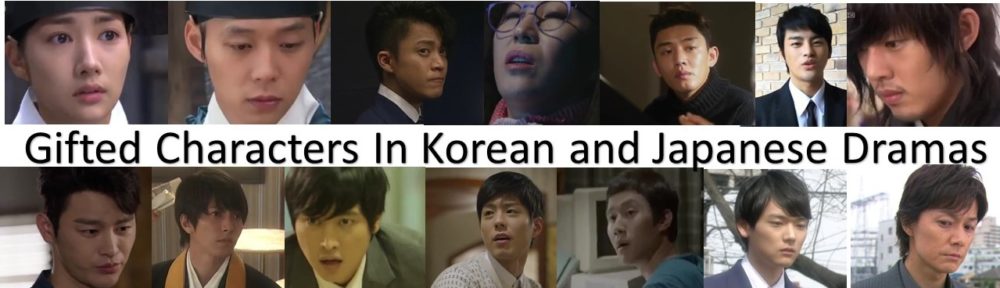
  • Gifted Characters In Korean And Japanese Dramas

    Gifted Characters In Korean And Japanese Dramas

    The Korean Wave, known as Hallyu, has been sweeping Asia and the rest of the world in terms of entertainment for years, and there is no sign of abating. With East Asian countries placing strong emphasis on academics and other areas such as music, it is no wonder that some of the lead characters in dramas are gifted.

    Many of the characters are young male students who easily top their studies, and good looks are mandatory. Many are portrayed with mega memories. Some are talented in sports as well. They are sometimes portrayed with inflexibility, with a strong sense of justice. Some have poor social skills. Some might be caricatures, but the actors and actresses who portrayed them were usually convincing. Most of them become better characters at the end of the show.

    gifted characters in korean and japanese dramas header

    Since romance is a key component in dramas, sometimes the male gifted characters are paired with female characters who are very weak in their studies, and are full of romantic ideals. The two female gifted characters mentioned here have to hide their identities in one way or another. The last time where there was a very strong female gifted character, it was Jang Guem (Chang Jin) in Jewel in the Palace (2003), a girl in historic Korea who manages to be an expert chef and then a medical doctor in the imperial court.

    Who are some of the gifted characters in some of the Korean and Japanese dramas in recent years? Let’s check them out. Note: I have not watched that many drama serials, so these are based on what I have watched and enjoyed recently.

    1. Choi Taek, professional Baduk player in Reply 1998 (2015/2016)
    park bo gum reply 1988
    This highly successful third installment of the Reply/Answer Me series, where the audience tries to guess who the husband of the lead actress is, showcases Choi Taek (played by Park Bo Gum) as a professional Baduk (Go, or Weiqi) player. He is said to have an IQ of 139 (if I remember correctly). He is a teenage world class player who beats much older Baduk players from Japan and China. Despite having dropped out of school just to turn professional with hordes of ardent fans, he remains grounded when he is with his family and friends.

    When it comes to Baduk, he behaves like an adult, masking his feelings and playing with a poker face, during competitions. He frequently has marathon matches, and gets headaches easily. With his highly competitive nature, he solves Rubik’s Cubes easily and gets the highest scores in arcade games. However, when it comes to daily activities, he is unable to handle them and depends on his family and friends to look after him. He needs help with tying shoelaces, boiling water and other simple tasks.

    Park Bo Gum, the actor, memorises Baduk moves from real competitions, and has received high acclaim for his performance in this show.

    2. Trash Oppa, Kim Jae Joon, medical student in Reply 1994 (2013)
    jung woo reply 1994

    In this second instalment, it is not explicitly mentioned that Trash Oppa, played by Jang Woo, is gifted. However, he is shown to be extremely good in his studies without having to put in extra effort. As a first year resident, he is quick to identify the problem in a patient based on medical charts and prescribes a detailed diagnosis when all the other students are unable to do so.

    However, he is nicknamed as Trash, because he is extremely messy in his habits, and is able to eat expired food and spoilt food without having any problem to his health. His house is so dirty that it is filled with garbage, empty beer cans, old food packages, and dirty and clean clothes in the same pile.

    Nevertheless, he is able to interact very well with people and patients, showing his high EQ as well. Elderly and young patients ask for him due to his good bedside manners. He is also an excellent soccer player, who easily turns matches around with his deft soccer skills.

    3. Yoon Yoon Jae, high school/law school student, judge in Reply 1997 (2012)
    seo in guk reply 1997
    In this first instalment, Yoon Jae, played by Seo In Guk, is the top student in his high school in Busan, and is the quiet brooding type. Apart from being good at studies, he is good at sports too. He is the top scorer in the whole of South Korea for his high school examinations. However, he wants to be an airforce pilot because he wants to impress a girl whose grades are average, but great at writing fan fic. In the end, he goes to the law faculty in Seoul University, and becomes one of the youngest judges who is extremely impartial and inflexible. He has a close group of friends.

    4. Yoon Tae Woong, teacher/computer programmer/CEO in Reply 1997 (2012)
    song jong ho reply 1997
    Tae Woong is Yoon Jae’s elder brother. He is also the top scorer for the national examinations, but gives up his chance to go to Seoul University to remain in Busan to look after his younger brother since both parents passed away. After his brother finishes his studies, he starts his own company and set up ILoveSchool website, similar to Friendster, to connect friends with their old schoolmates. He becomes very rich. He is a gifted computer programmer who can debug easily and codes in a very short period of time, sometimes even doing his employees’ work. After that success, he goes on to create another big success, similar to Myspace. At the height of his company success, he sells off his shares and goes to be a lecturer in the university. He even becomes a presidential candidate.

    5. Lee Sun Jae, gifted pianist in Secret Love Affair (2014)
    yoo ah in secret love affair

    He is a gifted pianist in his twenties, having picked up the piano on his own through watching videos online and downloading sheet music. To learn a piece, he listens to a recording hundreds of times and memorises it. He does not realise how talented he is since he comes from a very poor family. He improvises music meant for duets, and he changes notes due to his finger injury.

    A former talented pianist, a married woman in her forties, discovers his talent and gets him into a university music programme on a scholarship. In the process, he connects emotionally with her when they played duets together and they fall in love with each other. This drama series has a lot of virtuoso performances.

    The actor, Yoo Ah In, learnt to play the piano for the drama and has been lauded for his performance. He would memorise the difficult pieces and play it for real, instead of many actors who pretend to play.

    6. Kim Yoon Hee, gifted female scholar who disguises as a boy in Sungkyunkwan Scandal (2010)
    park min young sungkyunkwan scandal

    This is a fusion period drama set in the late Joseon period (18th century). Only men were allowed to study. Kim Yoon Hee (played by Park Min Young) cross dressed as a boy in order to earn a living as a writer. She ghost writes theses for scholars in Sungkyunkwan, a prestigious Confucian institute for top scholars. When she loses a script, she writes it out again from memory. Her late father was actually a professor at the same institute. When she was young, her father would read to her baby brother difficult works in a room while she stood outside to learn on her own. Her father soon realised her giftedness, but was unable to do much at that time.

    Through a series of events, she is ordered by the king to enter the institute. Due to her eagerness to learn, with the promise of food and medicine which she could give to her family and sick younger brother, she assumes her brother’s identity, Yoon Shik, to enter it. She continues to be one of the top scholars in the institute. She even learns archery in a week just to prove herself through sheer determination and hard work.

    7. Lee Sun Joon, gifted scholar, son of Left State Minister in Sungkyunkwan Scandal (2010)
    micky yoochun sungkyunkwan scandal

    Lee Sun Joon, played by Micky Yoochun, discovers Yoon Hee’s talent when she is taking the test on the behalf of a client. He exposes her so that she has a chance to go to the institute. At that time, he does not know she is a girl.

    He is a gifted scholar as well, and is known for being inflexible.He has a strong sense of justice, and is willing to expose the truth even if it means implicating his own father. Apart from being academically gifted, he is also equally talented in sports. He trains himself to shoot with his left hand after injuring his right shoulder, and is able to shoot the bull’s eye. In order to win the competition, he trains his roommate, Yoon Hee.

    He falls for her, thinking he is a homosexual, and even thinks of entering a political marriage just to escape his feelings. However, he could not go through the wedding and chooses to run away just to maintain Yoon Hee’s honour due to the highly conservative nature of the society then.

    8. Moon Jae Shin (Geol Oh), gifted scholar and martial arts exponent in Sungkyunkwan Scandal (2010)
    yoo ah in sungkyunkwan scandal
    This character is acted by Yoo Ah In (same actor mentioned earlier). He challenges the system by dressing up as the Red Messenger and is extremely upset by the death of his elder brother, who was the top scholar in Sungkyunkwan. He would leave provocative messages about the truth of the death crown prince Sado and he gets seriously injured from clashes with the military.

    Apparently, he is an even better archer than Lee Sun Joon, and he is even smarter than both Kim Yoon Hee and Lee Sun Joon, as he could tell who had the right answer in a competition held by the king. He had read all the books in the library, but he skips classes, refuses to do his work, and pretends to be an average student.

    The three scholars and another student, acted by Song Joong Ki (who acted in the recent highly popular Descendants of the Sun and is an extremely intelligent person himself) form Joseon F4, famed for their looks.

    9. Jo Min Ja, gifted hacker in Healer (2015)
    kim mi kyung healer

    This is a rare portrayal in Korean drama land as the gifted characters are usually good-looking young males. She is a woman in her late forties, and she is an expert at hacking into various computers, including the police’s internal computer system, street cameras, and other organisations.

    She hides in a room with many fast computers and the latest IT gadgets, including all sorts of tracking devices. Without revealing her identity, she assists Healer, a young guy who is great at Parkour and running all sorts of errands for rich people including the triads for a high fee.

    10. Lee Hyun, criminologist, I Remember You/ Hello Monster (2015)
    seo in guk hello monster

    Acted by Seo In Guk (see number 2), Lee Hyun is a gifted criminologist. When he was young, he was already very mature and could run the household, looking after his younger brother. There was a family tragedy. However, his father, who was a policeman, thought he could be a psychopath, as there were numerous disturbing drawings, and mutilated animals. A mass murderer was on the loose, and due to various circumstances, the father was killed, and the brother went missing.

    As an adult, he became a criminologist and was able to profile criminals based on their modus operandi and signatures. He was able to spot details that nobody else could, and crack codes left by criminals, such as latitudes and longitudes coordinates.

    However, he is shown to be rather dismissive of people who are not smart, and has a rather abrasive personality at times.

    The serial killers in the show are shown to have high intelligence as well, but I will not reveal them here in case it spoils the mystery for you.

    This show, and another excellent show, Signal (2016), led me into profiling of criminals. I had actually looked up some information from the FBI, and it was quite insightful on how certain things done by criminals could lead to police zooming in on suspects. Whether a criminal brought a weapon to the scene, or used items from the scene as weapons showed whether the criminal was an organised one or disorganised. This field is fascinating, but extremely gruesome, so I think it will take certain types of personalities to take up such jobs.

    11. Irie Naoki, gifted student in Itazura Na Kiss (Love in Tokyo) 2013
    furukawa yuki itazura na kiss

    There are other versions of this show, It started with a kiss (Taiwanese) and Playful Kiss (Korean). This show is adapted from a manga, and in the Japanese version, Irie-kun is a gifted student, with a rumoured IQ of 200 (What test are they basing this on?). He can memorise things after he has read them once. He could cook a dish after looking a recipe once, and plate it just like the picture.

    He tops the examinations easily, and even tops the national entrance exams despite being injured and groggy from medication, with only just 30 minutes. He had demonstrated excellence and interest in various fields, such as science and technology, literature, languages, marketing and medicine.

    He is the target of many high school girls, and he gets involved with a girl, Aihara Kotoko, who professes her love for him in front of many people and cruelly rejected. The girl is an average student who is in the last class. Due to an incredible situation where her new house collapses from a meteorite and shoddy workmanship, the girl and her father moves into Irie’s house as the parents are best friends.

    He is shown to be mean-spirited, but she manages to blackmail him to tutor her. He easily spots the questions for her, sets her questions to do, and explains them to her. He is also a top tennis player with shots that are extremely powerful and fast. Due to a competition, he is forced to teach her as well, and puts her through a gruelling practice.

    12. Hoshikawa Takane, Buddhist monk, From 5 – 9 (2015)
    Yamashita Tomohisa 5-ji kara 9-ji made

    Takane (played by Yamashita Tomohisa) is a handsome Buddhist monk who is slated to be the next head monk. He is extremely intelligent, having graduated from Tokyo University. He is proficient in English as well, but he attends English classes in order to pursue Sakuraba Junko, an English language teacher. (Note: Monks in Japan are allowed to get married.) He is extremely good at cooking and a lot of other things, and he also shows a very strong interest in natural history, especially dinosaurs and animals. He easily memorises the scriptures so that he could conduct various religious ceremonies. He could remember everything about Junko and has a kind personality.
    The only fault is that he is extremely persistent, and is verging on the point of stalking despite Junko telling him she does not like him at all.

    13. Hyuga Toru, IT whiz, CEO in Rich Man, Poor Woman (2012)
    oguri shun rich man poor woman

    Hyuga Toru owns an IT firm, Next Innovation, with his friend. He is extremely intelligent, and able to code extremely well. He has many big hits, and then tries to come up with something that could benefit the public. He can code complex databases, but then he is also able to really identify the users’ needs and rebuilds the whole system just to make it more user-friendly. However, he cannot remember faces, and can be quite rude to people. He suffers betrayal, but is able to bounce back.

    14. Yukawa Manabu, Physicist in Galileo 2 (2013)
    Fukuyama Masaharu galileo 2

    Played by a multi-talented actor/composer/musician/singer, Fukuyama Masaharu, Yukawa is a physicist who is roped in to help the Japanese police solve mysteries by using physics. He is a little eccentric, and is more interested in solving science problems than murder mysteries. Strange occurrences are explained, and it is interesting to see how his brains works. Apparently, the first season was even more exciting.

    This blog post is part of a blog hop on Gifted in Pop Culture by Hoagies’ Gifted Education Page.
    image

  • 7 Tips For Parents With Gifted Children

    7 Tips For Parents With Gifted Children

    So what happens after you discover your child is gifted after being told that he or she is gifted? Or perhaps you just had an aha moment after he or she did something way unusual for a child?  Here is a quick start guide for parents.

    7 tips for parents with gifted children 4

    1. Find support for parents of gifted children. Parenting gifted children is lonely. Friends may not understand you that much, especially if your children’s milestones are way ahead of theirs. Others who have been there may offer help. There is no need to worry that much about your children.

    2. Advocate for your gifted children. Chances are some of them may face issues in school. They could be bored from the lessons, and some may act out. It is even more difficult if your children are twice-exceptional. Your child may need acceleration, but do the school district boards allow? Find ways to work with the teacher, not against the teacher. Very few teachers are trained in gifted education. Even if they are, there are so many different faces of gifted children, that they may not be able to handle your child. You should do what you can for them.

    3. Read up. Google whatever you can. Borrow library books. Read sites dedicated to giftedness such as Hoagies’ Gifted Education Page and SENG. Share what you have found out with your spouse or other family members so that they could understand your child better. Learn the acronyms and jargons. What is twice-exceptional? What is EG and PG? What is asynchronous development? SB5? WISC-IV? Intensities? You can check out Hoagies’ Blog Hops for discussion on various issues.

    4. Decide whether to send your child for gifted testing. Taking IQ tests is not cheap, but the test results may offer you some answers to what your child is facing. There might be a discrepancy between processing speed and working memory, and that is why your child has certain issues. Which test should is more suitable? Which psychologist should you go with? If there is no real need to know your child’s score, if your child is doing well in school, and you are not looking for acceleration, do you still test?

    5. Help your children to find friends. Many of them are able to make friends with older children and adults. Some may need a bit more of a push. Help them find true peers instead of just age peers. You can let them join clubs in sports or other interests, where they could be at more similar levels, or they could have common interests to talk about. You can even help them to find pen pals.

    6. Allow your child to flourish. Allow them to play. Learn about their interests. There is no need to push them intellectually. Give them free time to explore, and create their own stories or things. They can be great in one area, but terrible in another area. Celebrate their successes, and do not harp on what they cannot achieve. Strike a balance between pushing them too hard, and not pushing them at all. They may excel academically, but want to do something completely different. Be rest assured they will excel in what they like too. Allow them to fail too, because you do not want them to have a smooth sailing life without facing any issues, only to stumble really hard when they are at the top.

    7. Work on their character and other life skills. Bring them up to be useful citizens, responsible, humble and people of integrity. They are so smart that they need to be grounded in good values so that they will not go the wrong direction. Teach them how to keep their own things organised. Teach them how to behave in social settings. Teach them how to interact with people. Teach them how to be disciplined and not give up easily. Teach them resilience. Teach them independence. Teach them how to say please and thank you. In fact, don’t just teach. Model the values and skills.

    This post is part of a monthly blog hop by Hoagies’ Gifted Education Page on Gifted 101.

    gifted 101


    Related Posts Plugin for WordPress, Blogger...