Author: Sarah

  • Singapore in the 60s by James Suresh Book Launch

    Singapore in the 60s by James Suresh Book Launch

    Having read the Mr Kiasu comics when I was growing up, I couldn’t resist the chance to meet one of the co-creators, James Suresh at his book launch. He has written a new book, Singapore in the 60s, illustrated by Syed Ismail.

    singapore in the 60s


    It was held at Queenstown Primary School, which was an apt location because the book was about his growing up years in the area, and he had attended this school. This school has a tree house in the library! As a former library co-ordinator, this is something extremely exciting to me.

    treehouse library

    I was early and had lots of time, so I took a selfie.

    Sarah Tan

    The book launch finally started!

    Suresh was a great storyteller, and he regaled us with many amusing tales.

    james suresh previous works

    He said that Brian Richmond used to play soccer in the school field, and he would wash his feet in the basin, hence his former principal actually wanted to ‘scold’ him at the book launch. Unfortunately, the retired principal was unwell and could not make it to the launch.

    Queenstown  was the first satellite town, and there were flats where the people lived in.

    4 storey housing

    People of different races lived next to each other, and the children would watch Cantonese dramas and Malay Pontianak shows at their neighbours’ houses. There was also a Chap Si Lau (Fourteen Storey Flat), which was infamous for the number of suicides.

    There was one incident which he remembered clearly. A man was sitting at an outdoor noodle stall having his meal. 3 gangsters came and tried to attack him with sticks and parangs, but this man managed to fend off the attack with a chair. The best part was after the gangsters fled, the man sat down and continued with his dinner.

    fighting gangsters

    Even though I grew up in the eighties, twenty years after the book was set, many of the events were familiar to me. My nanny lived in a ground floor unit of a four-storey flat too. I would run around the area with the neighbour’s children. Once, I must have done something wrong, and she chased me with a cane and I ran all the way to the other end of the block of flats, which I had never done before. Apparently, it had also happened to James Suresh and his friends, amusingly captured in the drawings.

    chasing with a cane

    He also wrote about games girls played in the past, such as hopscotch, zero point (he used a different term) and five stones, something which I played in primary school too. For the boys, they caught spiders and fish from longkang (drains) and made kites with glass strings aimed to cut other kites. There was also a milk programme for undernourished children. I remembered ordering packets of chocolate milk in school though.

    Various occupations (Samsui women, nightsoil collectors, milkman, teh Tarik men, and more) and other recreational activities were introduced. This is fantastic for Secondary One students taking history. I am no longer teaching history, but I will still introduce the book to my students. The time frame does not fit that well, but many of the activities were similar. All these memories and events were captured in realistic and funny comic drawings. It would make very good material for history lessons.

    Unfortunately, because he had been living in flat since he was born, he did not mention about kampongs. I had grown up in a kampong, living in a zinc-roofed house. Whenever it rained, the roof thundered. My cousins would pluck hibiscus that were in the garden to suck the sap. Some would explore the garden and cut down the trees. My mother did not let me explore the place that much though. It would make good stories though.

    Other speakers also recounted their childhood, such as Dr William Wan, General Secretary of Singapore Kindness Movement, Dr Chia Shi-Lu, MP of Tanjong Pagar, and Brian Richmond, the veteran deejay. Dr Wan remembered the Redifussion radio, where Lei Dai Sor, a famed storyteller would always end his radio shows with a cliffhanger.

    dr william wan

    Brian Richmond talked about how he used to tease girls from nearby schools, and managed to date his future wife whom he met when they were 14 and 15. He became a policeman and his wife, a teacher. They held their wedding dinner with four tables at Golden Crown Restaurant. It was interesting seeing him in the flesh.

    brian richmond After their talk, the author and illustrator autographed their books and took a picture with the VIPs.the vip

    I managed to get a (blurred) shot with them and received an autograph.

    posing with author and illustrator


    What’s great is that every school will receive 10 copies of the book as part of the SG50 grant.

    I had shared the book with Gar, my three-year-old son, and he enjoyed the stories, including one that had a floating pig carcass, and the one of the hardcore gangster.

    Note: I received the book, Singapore in the 60s, for review.

  • Sisterhood Of Mothers With Gifted Children

    Sisterhood Of Mothers With Gifted Children

    Sisterhood of Mothers With Gifted Children

    I feel as if I have been inducted into a secret sisterhood which few people dare to mention. This guild is lonely, but once a member pops up, you do your best to connect. This is the secret sisterhood consists of mothers (and perhaps fathers) of gifted children.

    Once upon a time, you could just show your video of how excited you are about your young child who could type  song lyrics at age 2. After a few more videos of interesting discoveries as your child gets older, you start to notice how your friends (with children of the same age are not doing the same thing), and the crowd have strangely grown silent. This is when you realise you have ventured into unknown territory, where people think you are showing off or hothousing your child, but you are actually at a loss on what to do with your child. When you finally realise that your child is gifted, after months of googling and wondering how many of the characteristics could be checked, you start to search for parents with similar children.

    When other parents reach out to you, it is almost like a lifeline. You get to share more about the issues that their children are facing, and what resources they have already found. Perhaps it could be about interacting with the gifted education branch. Perhaps it could be about sharing homeschooling materials. Perhaps it could be simply just happiness about having another person to talk to and that you can form new relationships with other parents of gifted children.

    Joining groups such as Hoagies’ Gifted Education Page allows me to strike up conversations with other parents, and also tap on their vast experience on issues such as dealing with gifted friendships, advocating for gifted children, and finding reliable testers. Having this blog also allows others to reach me. Some of them are worried about their children who had teachers who could not handle their immense curiosity and incessant questions. Others have seen family members and friends downplay their children’s numerous early milestone achievements and other gifted characteristics.

    Occasionally, you realise that a friend’s child is advanced, and you reach out. If the other parent speaks the same language, you are extremely happy that you have finally found a comrade. With friends who have younger children, sometimes I get to see videos of what their children are up to. I would observe possible characteristics and I raise the possibility that their children could be gifted. For many, it is the first time they are hearing this.

    Most of the people I know with gifted children are women since mothers tend to discuss their children more, hence the term sisterhood, but occasionally I get to know fathers with gifted children too, and they have taken more active roles in their children’s education and interests.

    Psst, are you already in this sisterhood?

    This post is part of a blog hop by Hoagies’ Gifted Education Page in July on Gifted Relationships.
    gifted relationships

  • The Art of Lying

    The Art of Lying

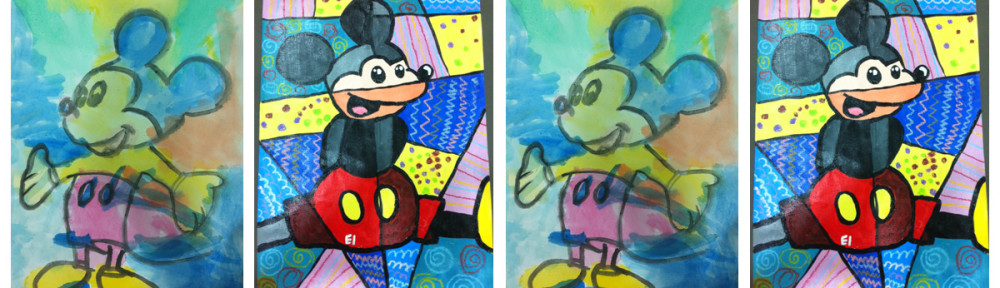
    the art of lying mickey mouse painting
    After weeks of missing lessons, El finally finished his painting of Mickey Mouse. His teacher had explained the concept behind it, but I had forgotten who the artist was. It was supposed to be have vintage feel, with all the patterns and designs behind Mickey Mouse.

    mickey mouse el vintage painting

    When I saw it, I liked it very much. His current art school, HeART Studio, is more interesting than his previous school, where they did blending of colours all the time. He has a greater sense of achievement here because he gets to see his completed works on canvas or on paper, instead of sketches in a notebook.

    When we went home, Gar saw the painting and immediately became insanely jealous. He started saying it was his. We brushed him aside and said it was done by his brother. Agitated, he threw a tantrum.

    “I painted this,” he reiterated, when he saw the painting on the wall the next morning. He was lying through his teeth and became upset when we repeated that it was done by his brother.

    I had remembered reading articles about lying. Lying is actually a good thing for the children, because they require cognitive skills to tell them. The earlier they lie, the brighter they are. However, we have to guide them and not let them get away with lying. If not, they will continue lying as they get older.

    I went to search for the articles and read them. According to Victoria Talwar and Kang Lee’s developmental model of lying, they mention that at the primary stage of lying, which occurs around age 2 to 3, children lie blatantly. It is very easy to tell they are fibbing, because it is impossible for the event to happen. Gar’s lie was easily exposed. At the secondary stage of lying, which occurs around 4 to 5, children tell lies that are more plausible. At the tertiary stage of lying, when they are around 7 to 8, they will tell lies that depend on facts and they have follow ups.

    The articles mentioned that we do have to address the issue right away, and not much later. We should not let them get away with the lies. Young children might not be able to tell between make belief and reality, hence the tall tales. He could have told the lie because he had liked it very much and had imagined himself drawing that. However, he did not express it the right way.

    We should also avoid showdowns, and not accuse them of what they did. Very young children do not know that they are in the wrong. Instead, we could talk about the other party’s feelings, or mentioned that something had happened.

    To resolve his issue, I asked him later in the evening who had painted that. Again, he said he did. I was a little glad he did, because that meant I could address this properly this time round.

    “Do you like this painting very much?” I asked.

    “Yes,” Gar answered.

    “Do you want to have your own painting like this too?”

    “Yes.”

    “Do you want Mummy to paint Mickey Mouse with you?”

    “Yes.”

    “This painting is done by Kor kor (El). Is it very nice?”

    “Yes.”

    I took a deep breath, and hope that he would be able to tell the truth this time round.

    “Who painted this?” I asked again.

    “Kor Kor.”

    I heaved a sigh of relief.

    El was in the living room when this exchange happened. I told Gar to tell El that his painting was very nice.

    Gar shouted, “Kor Kor, your painting is very nice!”

    El kept quiet and pretty much ignored him. I went to El and told him that someone had just paid him a compliment. He should acknowledge that and thank the person.

    After some probing, El finally said, “Thank you for your compliment.”

    I went back to Gar, and told him what to say.

    “You are welcome!”

    Children need to be taught how to respond in different social situations. I find that El can be quite nonchalant at times, and I need to get him to greet people, including his teachers and friends, or say goodbye to his friends.

    Going back to the painting, I sat down with Gar to do the painting. I searched online for a picture of Mickey Mouse, and asked Gar which one he wanted. He said he wanted a blue Mickey Mouse, and selected a picture. I sketched it out, and got him to paint.

    He had been doing some painting with my mother, who is very talented in drawing. My mother had reminded me to use the white colour to mix with the colours, so that the pictures would be more dimensional instead of flat.

    He wanted various colours for different parts of Mickey Mouse, and after he had painted the mouse, I got him to paint the background. When he was done, I added the outline to make the picture a little better. I also added some touch ups to the side.

    mickey mouse gar painting

    Gar was extremely proud of his painting and demanded that we put up his artwork on the wall too. When he observed that his brother’s painting had a name, he asked to include his name on his artwork too. His father wrote his name and he was as pleased as a lark.

    Related Posts Plugin for WordPress, Blogger...